Ruth Pablo Juan spent four months turning a failed lab exercise into a chemistry experiment her professor could not find anywhere in the academic literature.
Pablo Juan, a Beaverton High School graduate and second-year Portland Community College (PCC) student, is one of four classmates who developed a three-component distillation experiment in organic chemistry. The project boosted ethanol separation purity from roughly 40–60% to nearly 90%, according to a PCC article published Sept. 28. Most college-level distillation labs use only two liquids.
The research started after Pablo Juan's first attempt at a two-component distillation fell short during her opening term of organic chemistry. PCC Chemistry Department Chair Ted Picciotto, who spent years in the wine industry before joining the college 17 years ago, invited her and two classmates to try building a better experiment. The group grew to four students and spent four months at PCC's Sylvania Campus running trials.
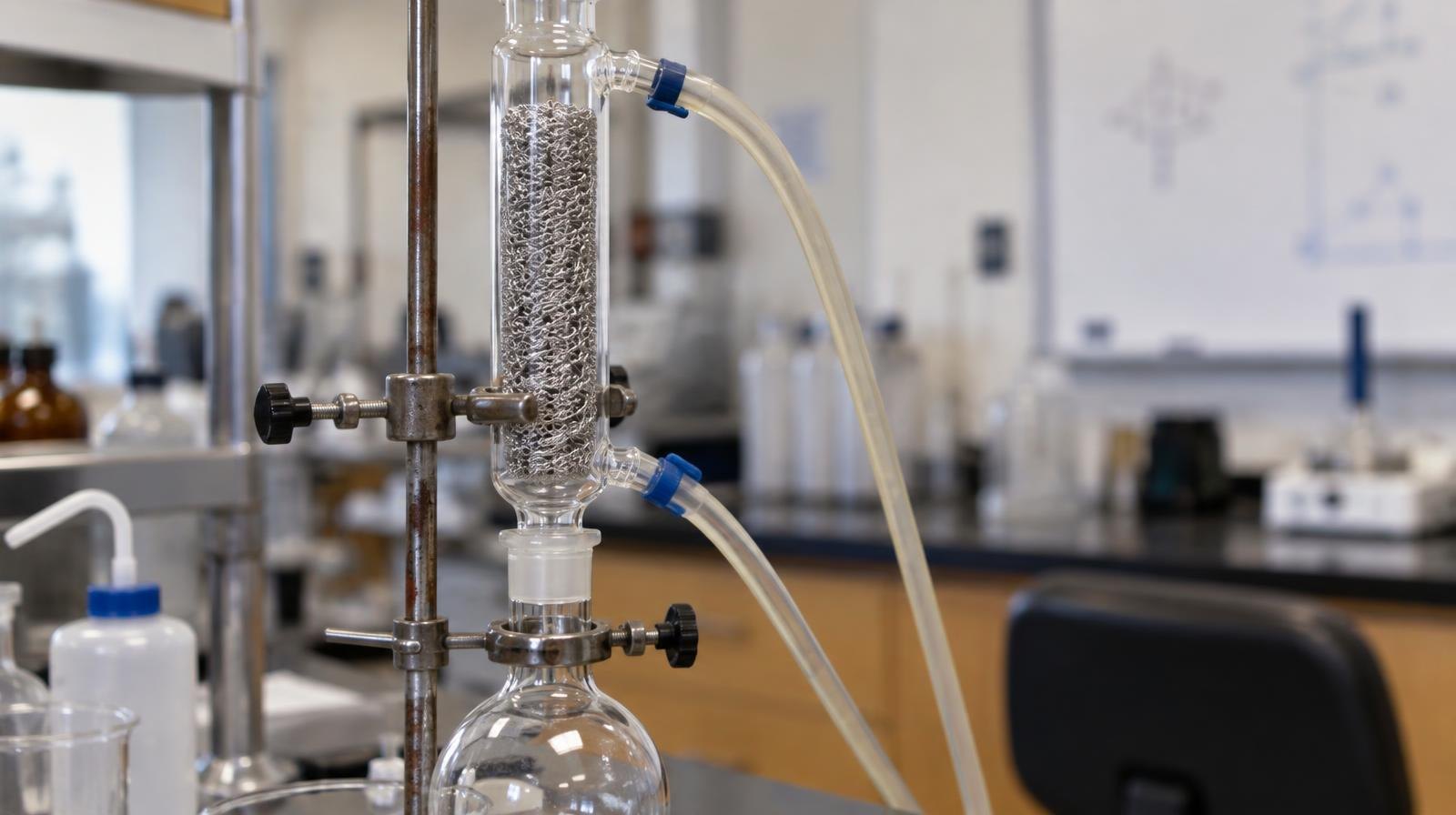
The team added stainless steel wire mesh inside the distillation column, an idea generated with the help of artificial intelligence. That change pushed ethanol purity in their samples from the 40–60% range to nearly 90%, with only small amounts of other chemicals remaining. They used gas chromatography-mass spectrometry (GC-MS) to measure what was in each sample and Fourier-transform infrared spectroscopy (FTIR) to identify individual chemicals.
Picciotto said he could not find a comparable three-component distillation experiment in the chemical education literature. "The most exciting part is that this is not simply a laboratory exercise with a predetermined answer," he said.
"Not only am I learning more about the field I am studying and gaining hands-on experience, but I am also learning how exciting it truly is to be doing something I am passionate about," Pablo Juan said in the PCC article.
Pablo Juan, who is based at PCC's Rock Creek Campus, earned an associate degree in general studies in spring 2026. She plans to transfer to Portland State University by fall 2027 to pursue a bachelor's degree in biochemistry and eventually a master's degree.
Her three teammates are Miguel Gomez, Kana Heitzman and Alondra Ramirez-Sierra of Canby. Ramirez-Sierra, a PCC Foundation scholarship recipient, spent extra hours in the Sylvania Campus lab over the summer. Lab research of this kind is often restricted to upperclass or graduate students at four-year universities, according to the PCC article. The experiment has potential applications in fields such as alcoholic beverage production.
Whether the experiment will be formally published in a journal or adopted into PCC's curriculum has not been announced.
Upcoming Beaverton community events:
- Sept. 30: THPRD free historical tour at Jenkins Estate
- Oct. 6: Rep. Bonamici town hall in Beaverton
- Oct. 17: Beaverton-backed studio tour featuring 50 local artists