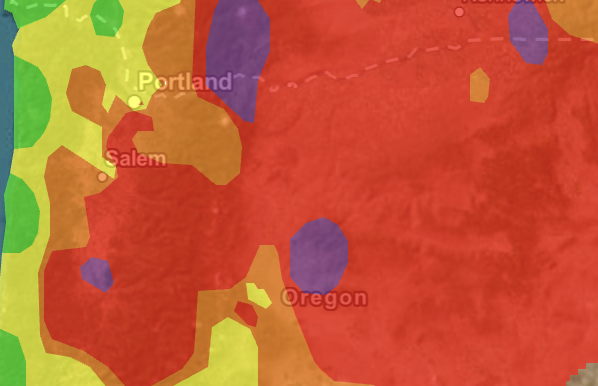
Children under 4 and adults over 75 are showing up in Washington County emergency rooms at higher-than-expected rates as wildfire smoke continues to blanket Beaverton.
The overall number of ER visits for noninfectious respiratory illness remains within the normal range for this time of year, according to county health spokesperson Afiq Hisham. But those youngest and oldest patients are making up a disproportionate share of who's seeking care. Ninety percent of patients had an underlying chronic disease.
The county declined to release exact visit numbers, calling the figures identifiable health information.
Beaverton sits in the thickest smoke. National Weather Service meteorologist Noah Alviz told the Beaverton Valley Times on Aug. 5 that "the thickest smoke in Washington County is in the east, so Beaverton and Hillsboro." Air quality in both cities reached as high as AQI 138, rated "unhealthy for sensitive groups," by early afternoon Wednesday, Aug. 5.
The Oregon DEQ air quality advisory covering Washington County is expected to expire at 10 p.m. Thursday, Aug. 6, according to KOIN. The National Weather Service expects smoke to begin clearing Friday, Aug. 7, as onshore Pacific flow returns.
Statewide, younger adults surprise officials
While Washington County's youngest and oldest residents bear the local burden, a statewide finding from the Oregon Health Authority flipped expectations: adults ages 18 to 44 made up the largest share of patients seeking care for smoke-related illness across Oregon. OHA suspects older adults with chronic conditions are already taking protective steps, while younger adults may underestimate the risk.
"Folks who are in that younger cohort may feel a little bit less vulnerable," said Gabriela Goldfarb, environmental health manager for OHA's Public Health Division. "But it turns out it impacts everybody's health as well."
Why smoke hits kids and the elderly hardest
The culprit is PM2.5, fine particulate matter about 30 times thinner than a human hair. These particles travel deep into the lungs and can enter the bloodstream, making them especially dangerous for people with heart disease, asthma, COPD and diabetes. Children are more vulnerable because their lungs are still developing and they breathe more air relative to their body size than adults.
Common symptoms include burning eyes, coughing and a scratchy throat. OHA says residents should seek medical care if they develop painful or difficult breathing, or if smoke worsens an existing condition.
What Beaverton residents should do
OHA recommends:
- Limit time outdoors and avoid strenuous activity
- Spend time in cleaner-air public spaces like libraries and community centers if you lack air conditioning
- Use a portable HEPA air cleaner or a homemade box-fan filter indoors
- Wear a well-fitting N95 or KN95 respirator outside; cloth masks, bandanas and standard surgical masks do not effectively filter smoke particles
OHA does not have authority to cancel youth camps, sporting events or other outdoor activities. Goldfarb encouraged parents to use the agency's guidance to make the right choice for their child.
Residents seeking clean air or cooling shelter locations in Washington County can visit 211info.org or call 211 (1-866-698-6155), available 24 hours a day.