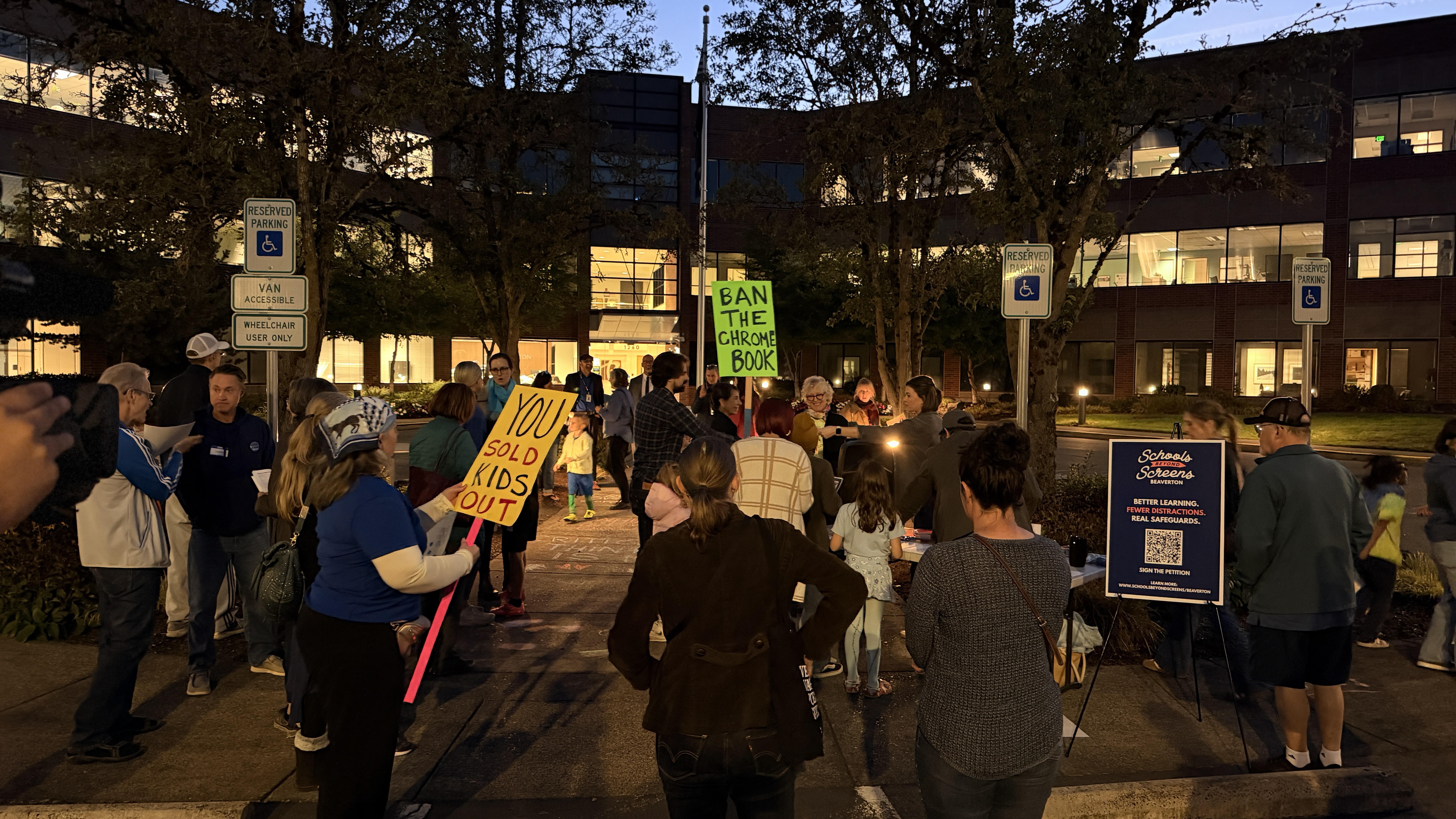
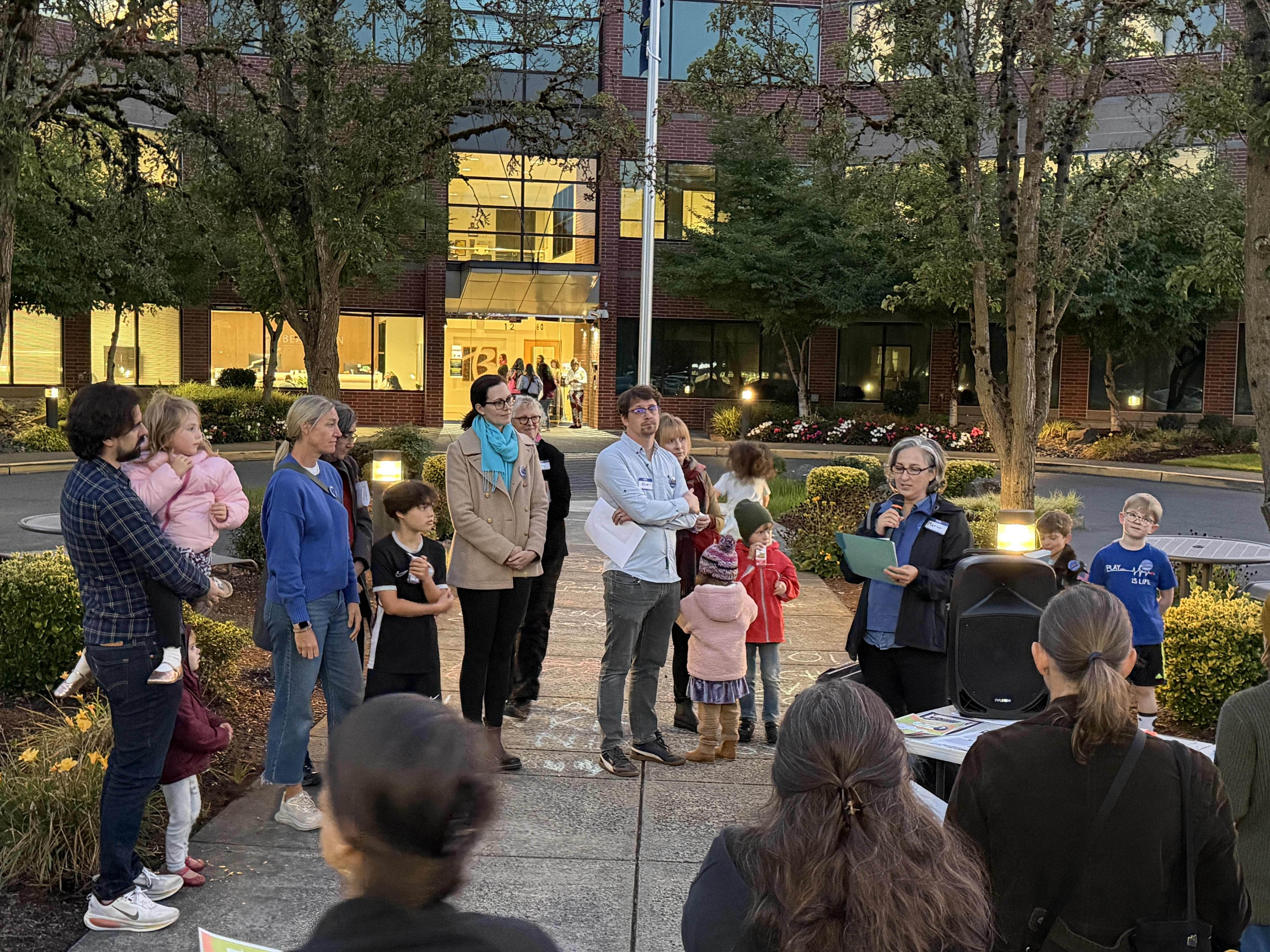
Around 50 parents, students and educators with Schools Beyond Screens rallied on Oct. 13 at the school district office ahead of the Beaverton School Board meeting, calling on the district to pause generative AI in classrooms until it adopts a formal policy.
The Beaverton School District has no board-approved and district-wide AI policy, and the new K-5 committee's charter puts AI outside its scope.
Schools Beyond Screens (SBS) is a coalition of students, guardians, parents, and educators who are monitoring corporate interests in the classroom regarding AI use. They are motivated by keeping a healthy learning environment that prioritizes mental health and safety, according to the organization’s website.
The group wants the district to freeze AI expansion, train teachers, assess risks, and bring parents into the conversation before students use AI further.
The school board held a working session during the rally, while community members who attended the rally outside the building received resources on data, policy, and ways to get involved.
"The biggest concern is that we may be giving students access to powerful AI tools before we fully understand their effects on learning, development, privacy, and well-being — or have clear guardrails in place,” BSD substitute teacher, parent, and SBS spokesperson Libby Sanford told Beaverton Beat in an email. "For BSD, we believe the district should prioritize student learning and safety over rapid adoption."
The school board meeting discussed Oregon State Assessments, student support for English language learners, and setting SMART goals. No AI policy was discussed.
According to Sandford, superintendent Dr. Smith expressed his gratitude for SBS’s enthusiasm to come outside together.
“While we appreciate that acknowledgement, we continue to be told that these are isolated concerns and individual instances rather than a systemic problem,” Sanford said.
The district launched a Purposeful K-5 Technology Use Advisory Committee on Oct. 6, drawing 164 applications for 35 seats. That committee will develop screen-time guidance for elementary grades by fall 2027. According to the committee's charter, developing an AI policy is explicitly outside its scope.
During the 2024-2025 school year, BSD adopted a Generative AI Advisory Committee where students, staff, and parents met four times for an hour each to discuss potential guidelines.
According to SBS, AI use is primarily being determined by BSD teachers during the 2026-2027 school year.
“There needs to be an AI moratorium so parents can feel confident about AI use, and it is only used in specific instances. Generative AI built into Chromebooks can be removed, and the district is not exploring this option,” SBS said in the email to Beaverton Beat.
Beaverton Beat reached out to the Beaverton School District media department and Montclair Elementary’s principal for clarification, but did not receive any response as of Oct. 14.
As of Oct. 13, 2026 and the day of the SBS rally, the AI section on the official BSD website mainly lists examples of AI and how AI works while linking to an official U.S. office of Educational Technology document, rather than specific situations that share how AI is explicitly used in classrooms.
Oregon’s education agency was the first to issue generative AI guidelines. The guidelines, issued in 2023, are voluntary. The state does not track which AI tools districts adopt. A new state law, Senate Bill 1546 (SB 1546), takes effect Jan. 1, 2027.
According to the legislation, it requires AI operators to disclose when users are interacting with AI, implement protocols for detecting suicidal ideation or self-harm, and add safeguards for minors. The bill passed the legislature on March 5 with votes of 26-1 in the Senate and 52-0 in the House.
The same review of the district's website on Oct. 13 found AI has the ability to write, help with problem solving, and assist with thinking during homework. However, SBS is firm on not letting it replace critical thinking and foundational skills that kids are learning as their brains are developing.
A national survey published Oct. 6 by Harvard University's Center for Digital Thriving found that just 18% of teachers and 24% of principals said their school had clear policies governing generative AI use. The survey of more than 1,000 public school teachers and principals also found that 74% of teachers who reported an AI-related dilemma described situations where students were suspected of using AI to complete their work.
An SBS petition with over 1,000 signatures encourages guidelines that support only-allow lists instead of website blocking, limiting screentime, issuing Chromebook sets, more teacher-led demonstrations, access district approved tools only, offer weekly parent reports and parent training, and send community surveys on EdTech.
Moving forward, Sanford says SBS plans to keep building relationships with teachers and propose less usage of individual iPads for grades K-2.
The next school board working session is Tuesday, Nov. 10.